Rishtan's Next Generation Is Reinventing Blue Ceramics — Carefully
The clay came out of the ground the color of dried apricot, not white, and that surprised me more than it should have. I'd assumed Rishtan's famous blue glaze was the whole story — that the color happened on top of something neutral. It doesn't. The local clay itself is reddish-yellow, workable straight from the riverbank with almost no refining, and every piece that leaves this town starts from that particular dirt before it ever sees a drop of ishkor glaze.
How I Got Here
I'd booked a half-day at a working ceramics studio in Rishtan as part of a small-group cultural craft tour of Uzbekistan's Fergana Valley — six of us, plus a guide who'd clearly done this enough times to know which questions the artisans actually enjoyed answering. I went in expecting a heritage-tourism version of pottery: watch an old man throw a bowl, buy something blue on the way out. What I got instead was closer to watching an argument in progress, conducted politely, between what Rishtan ceramics has always been and what it's about to become.
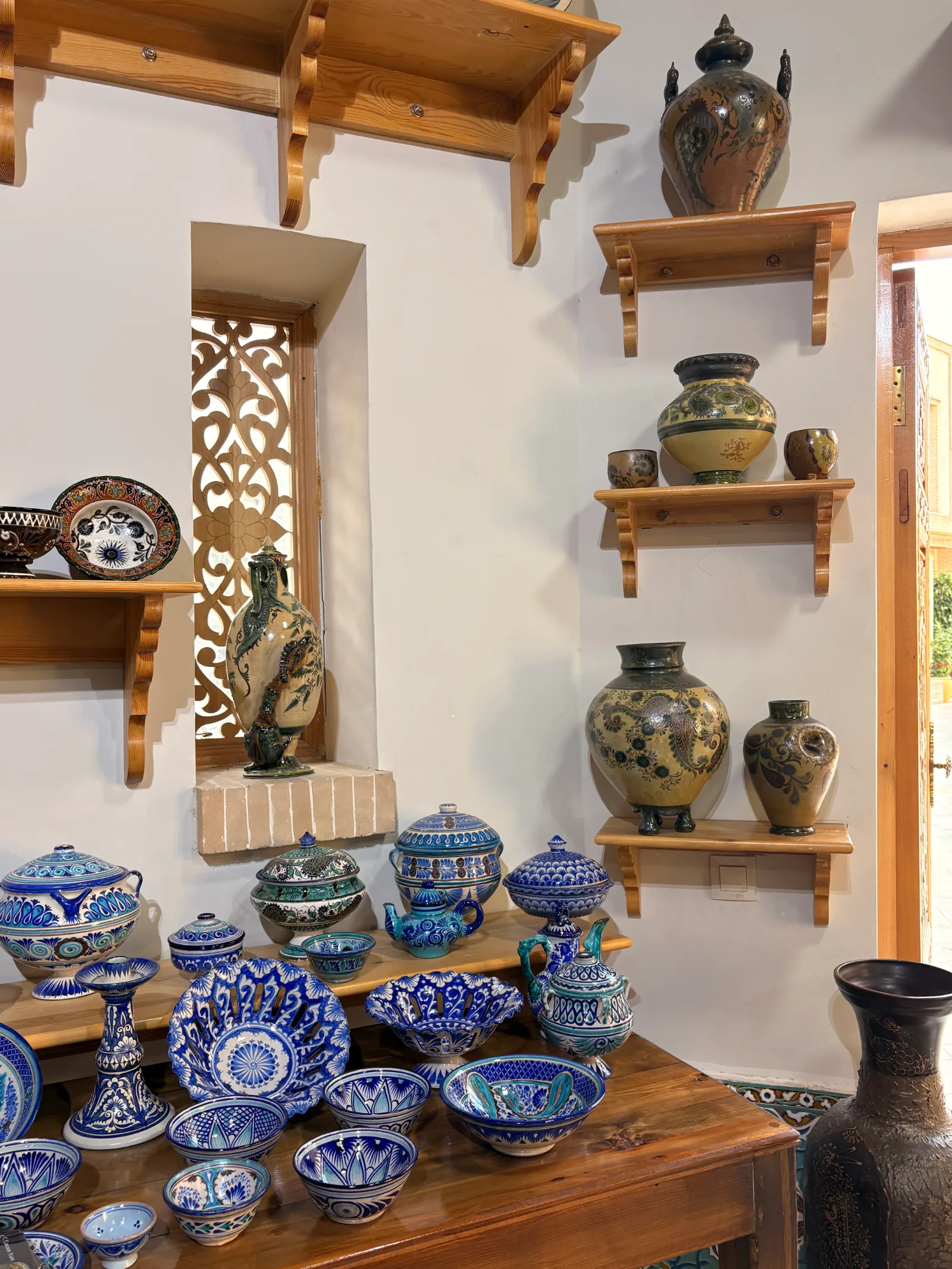
The workshop belongs to a master glazer, one of a small handful of families in town still mixing ishkor — the mountain-ash and quartz-sand glaze that gives Rishtan blue its particular depth — by hand, from a recipe nobody writes down. His workshop has apprentices, and one of them, mid-twenties by my guess, was working a section of the room set apart from the traditional forms: plates and bowls with the same cobalt-and-turquoise palette but geometry that didn't belong to any pattern I recognized from the shelves of finished stock along the wall.
The Craft Itself
Traditional Rishtan ware follows fixed pattern families — you can learn to recognize the rosette medallions, the almond-shaped boteh motifs, the botanical borders that repeat with only minor variation across generations. It's not decoration in the Western decorative-arts sense; it's closer to a visual vocabulary that's been maintained, argument by argument, for something like eight centuries, since before the Mongol invasions scattered the potters and the survivors slowly rebuilt the tradition from what they remembered.
What the younger apprentice was doing wasn't a rejection of that vocabulary — I want to be precise here, because "innovation" gets used loosely in craft tourism and usually means someone put a QR code on a teapot. It was pattern logic pushed somewhere the older generation hadn't taken it: negative space treated as a design element instead of a gap to fill, glaze pooled deliberately thick at the rim of a plate instead of evened out for uniformity. The master glazer stopped by twice while we were there, looked at the unfired greenware, and made one small correction each time — a line that needed to curve tighter, a section that would crack in the kiln at that thickness. He didn't touch the piece. He pointed, and the apprentice fixed it.
That's the whole tension in one gesture: the forms are opening up, but the physics of the glaze and the kiln are not negotiable, and the people who know that best are still the ones with forty years in front of the wheel.
What It Actually Felt Like
I got a turn at the wheel, briefly, at the plainer end of the studio's practice range — a small bowl, nothing ambitious. The clay was cooler and heavier than I expected, and it fought me for the first minute in a way that made the apprentice's fluency look like something closer to sleight of hand than skill, which is of course exactly backwards. My bowl came out lopsided on one side, thin on the other, the kind of thing you'd only keep out of stubbornness. I kept it anyway.
What stayed with me more than the wheel work was watching the glazing. Ishkor doesn't behave like a paint — it's thick, matte, almost chalky before firing, and the blue you associate with Rishtan doesn't exist yet at that stage; it only appears in the kiln, which means every glazer in that room is working partly from memory and partly from faith that today's batch will fire the way yesterday's did. The apprentice's hand didn't hesitate the way mine would have. He'd clearly done this specific gesture — a single loaded brushstroke along a rim — hundreds of times before I ever walked in, and it still wasn't automatic; he was watching the line the whole way, correcting mid-stroke.
Why the Small Group Size Matters
There were six of us in that workshop, and even then the room felt full. In a group of twenty, the master glazer would have been managing traffic instead of correcting greenware, and the apprentice would have been performing a demonstration rather than doing the actual work he had scheduled for that afternoon regardless of whether tourists showed up. The small-group format on this tour meant we were watching production, not a show staged around it — the unfinished pieces on the drying racks weren't props, they were Tuesday's order for a Tashkent restaurant.
That distinction is the difference between a craft tour and a craft visit. Rishtan gets tour buses; it doesn't get many groups small enough to actually watch a correction happen in real time.
What You Leave With
I left with my lopsided bowl, unfired and wrapped in newspaper for the trip home, and with a clearer sense of what "traditional craft" actually means in a town like this — not a museum piece frozen at some ideal historical moment, but a live argument between what's proven to survive the kiln and what someone in their twenties thinks the pattern language can still say. The knowledge that matters here isn't really transferable in an afternoon; what I got was a narrow, honest look at the edge where it's being renegotiated, generation to generation, correction by correction.
CraftNCulture runs this Rishtan ceramics session as part of its Fergana Valley small-group cultural craft tour, capped deliberately small so the workshops stay workshops rather than performances. If gold embroidery in Bukhara interests you as a comparison point for how differently two Uzbek craft traditions handle the question of innovation versus preservation, that's worth reading before you book either one.
Tour: Fergana Valley Ceramics & Craft Immersion, small-group (max 8), Rishtan workshop session included.
About the author
CraftnCulture
The CraftnCulture editorial team — Tashkent-based cultural tourism specialists covering Uzbekistan travel, artisan crafts, and Silk Road heritage.