CraftnCulture
首页旅游线路工作坊巴扎集市相册博客Book Now
首页旅游线路工作坊巴扎集市相册博客Book Now我的账户
Language:

保持联系

订阅我们的新闻通讯,获取工作坊更新、文化见解和独家优惠。

CraftnCulture

通过亲身实践的工作坊和沉浸式多日游,探索正宗的中亚工艺。在乌兹别克斯坦与工艺大师建立联系。

探索

  • 工作坊
  • 乌兹别克斯坦旅游线路
  • 巴扎集市
  • 相册
  • 成为合作伙伴

资源

  • 旅行博客
  • 关于我们
  • 常见问题解答
  • 订单追踪
  • 联系我们

联系我们

  • Emailinfo@craftnculture.uz
  • Phone+998 90 272 01 13
  • WhatsApp+998 90 272 01 13
  • Studio乌兹别克斯坦塔什干
© 2026 CraftnCulture 版权所有隐私政策条款与条件
Home/Blog/Destinations/Inside Ichan-Kala: Khiva's Khorezm Architectural Legacy
Destinations

Inside Ichan-Kala: Khiva's Khorezm Architectural Legacy

Explore Khiva's Ichan-Kala, a UNESCO walled city where Khorezm architecture, blue-tiled minarets, and Silk Road history still breathe across the desert.

CraftnCulture EditorialJune 9, 20264 分钟阅读
Inside Ichan-Kala: Khiva's Khorezm Architectural Legacy
本页内容▾
  1. Why Ichan-Kala Feels Different
  2. A Brief History of Khorezm
  3. Five Monuments You Should Not Miss
  4. A Word on the Tilework
  5. How to Read a Khivan Building
  6. Planning Your Visit
  7. References

本页内容

  1. Why Ichan-Kala Feels Different
  2. A Brief History of Khorezm
  3. Five Monuments You Should Not Miss
  4. A Word on the Tilework
  5. How to Read a Khivan Building
  6. Planning Your Visit
  7. References

Step into Khiva, and the centuries collapse around you. The desert town of Khiva Uzbekistan, set deep in the Khorezm region, holds something rare: a fully preserved walled city where every doorway, dome, and minaret tells a story carved over a thousand years. Most travelers visit Samarkand or Bukhara first — but those who make it to Khiva often leave whispering that this was the most magical stop on the entire Silk Road. The reason is Ichan-Kala, the inner fortress, and the unmistakable rhythm of Khorezm architecture that fills every corner of it.

Why Ichan-Kala Feels Different

Ichan-Kala is the walled core of old Khiva, declared a UNESCO World Heritage Site in 1990 — the first site in Uzbekistan to receive that recognition. Roughly 26 hectares wrap inside crenellated mud-brick walls that rise eight meters high and stretch for two kilometers. Within them stand more than 50 monuments and 250 traditional houses, all clustered tightly enough that you can walk the entire complex in an afternoon. Yet the density is the point: nowhere else in Central Asia can you trace the evolution of an Islamic city this completely.

What distinguishes Khiva is the silence. Where Samarkand dazzles and Bukhara bustles, Ichan-Kala holds its breath. The honey-colored walls glow at sunset, sand drifts gently across cobblestones, and the call to prayer still floats from minarets that pre-date most of Europe's cathedrals.

A Brief History of Khorezm

The Khorezm civilization is older than Khiva itself — references appear in Zoroastrian texts and Achaemenid inscriptions some 2,500 years ago. Khiva was a modest oasis stop along the desert caravan route until it became capital of the Khanate of Khiva in 1592, when the Amu Darya river shifted course. From the 17th century through the 19th, Khiva was a slave market, a scholarly center, and a stubborn holdout of independence — finally falling into the Russian sphere in 1873.

The architecture you see today crystallized during this Khanate period: a sober, geometric style that rejects the lavish mosaics of Timurid Samarkand in favor of disciplined turquoise tilework, carved alabaster, and intricately turned wooden columns.

Five Monuments You Should Not Miss

Before you wander aimlessly (which Khiva absolutely rewards), anchor your visit around these landmarks:

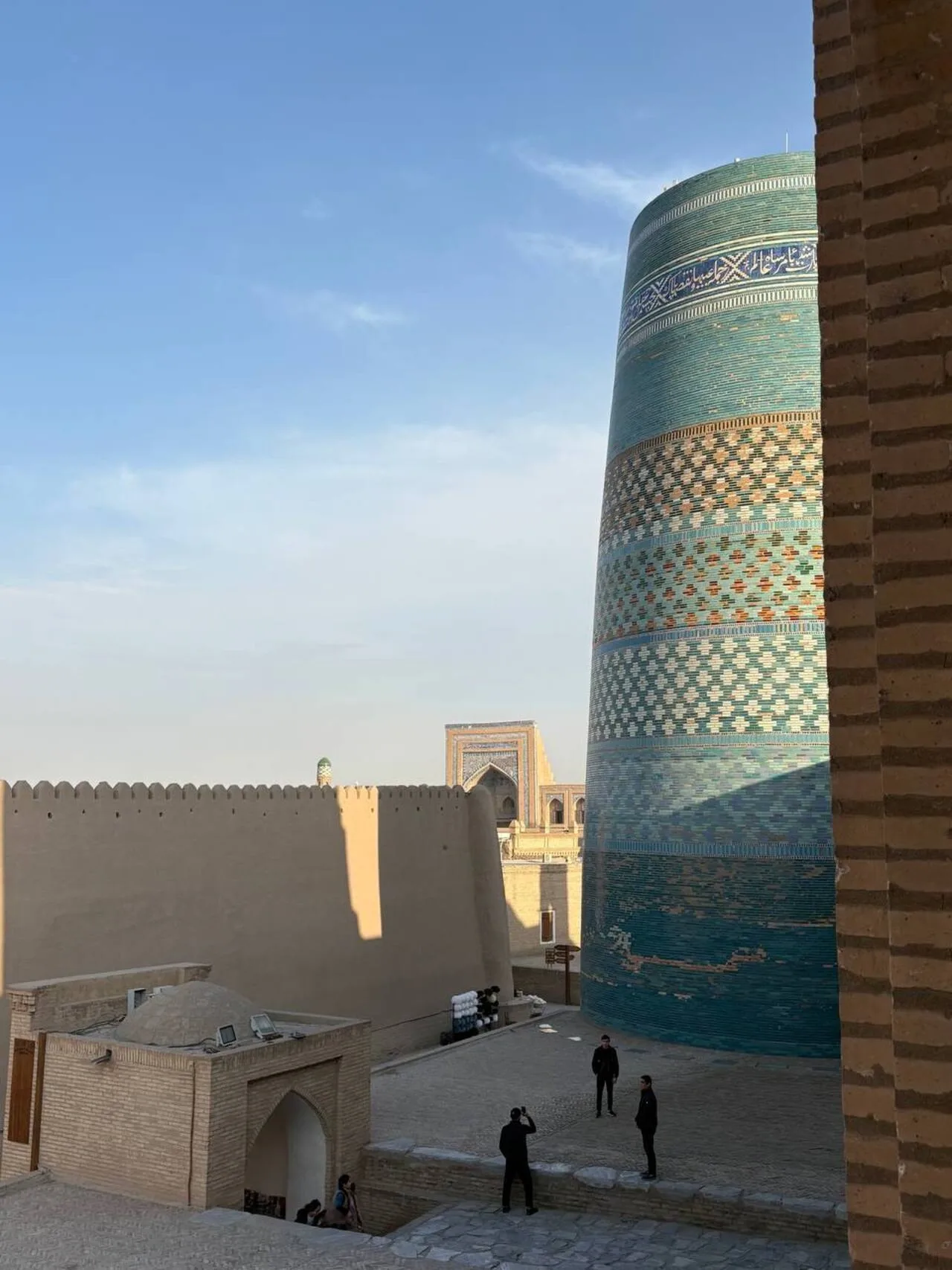
  • Kalta Minor Minaret — the unfinished, fat blue tower meant to be the tallest in the Islamic world, abandoned at 29 meters in 1855
  • Juma Mosque — 218 carved wooden columns, each unique, some dating to the 10th century
  • Kunya Ark — the khan's fortress, with a summer mosque whose tile work rivals anywhere in Uzbekistan
  • Tash Hauli Palace — 163 rooms organized around three courtyards, the harem ceiling alone worth the entrance fee
  • Islam Khoja Minaret — climb its 118 narrow steps for the view that defines every Khiva photograph ever taken

A Word on the Tilework

Khorezm tile masters worked almost exclusively in cobalt, turquoise, and white. The patterns are mathematical — eight-pointed stars, hexagons, vegetal arabesques — but never repetitive at close range. Ask a local guide to show you the deliberate "mistakes" inserted into geometric panels: a tradition reminding artisans that only Allah creates perfection.

How to Read a Khivan Building

Most visitors photograph and move on. A slower eye reveals more. Look for the carved alabaster ganch panels around mihrabs — they are sculpted, not stamped. Notice how mosque entrances are slightly off-axis from the courtyard, a Khorezm peculiarity meant to disorient evil spirits. Count the wooden columns inside the Juma Mosque if you have the patience: locals say no two are identical, and they are right. Some are reused from earlier mosques predating the Mongol invasion of 1220.

If you visit a madrasa, peer into the cells. The students who lived in those tiny rooms — sometimes for ten years — produced the manuscripts now scattered across the libraries of Tashkent, St. Petersburg, and Istanbul.

Planning Your Visit

Khiva is best in April–May or September–October, when desert heat eases and skies stay clear. Two nights inside Ichan-Kala beats a day trip from Urgench: when the tour buses leave at sunset, the city becomes yours. Stay in a converted madrasa hotel if possible — the rooms are spare but waking inside an 18th-century cell at dawn is a memory that outlasts any photo.

If you want to go beyond a quick visit, CraftnCulture organizes guided architectural walks led by local historians, plus visits to woodcarving and ceramic workshops just outside the walls — places where the same techniques you see in Tash Hauli are still practiced by hand. Whether you spend two days in Ichan-Kala or build it into a longer Silk Road journey, Khiva rewards travelers who slow down and look closely.

References

  • Itchan Kala — UNESCO World Heritage Centre
  • Khiva — Encyclopedia Britannica
  • Uzbekistan travel guide — Lonely Planet
  • Uzbekistan State Committee for Tourism Development
khivaichan-kalakhorezmsilk-roaduzbekistan-architecture

About the author

CraftnCulture Editorial

CraftnCulture Editorial contributes to the CraftnCulture journal, covering Uzbekistan's living craft traditions and Silk Road heritage.

与我们同行

Crafted in Uzbekistan: A 10-Day Cultural Workshop Journey through Uzbekistan

From $2150 per person

立即预订
本地贴士

日出后一小时再到访 —— 商贩更热情,光线更柔和,人群也尚未聚集。

相关故事

Samarkand Hidden Gems: Beyond the Famous Registan
Destinations

Samarkand Hidden Gems: Beyond the Famous Registan

June 9, 2026
3 分钟阅读
Karakalpakstan Travel: Aral Sea Desert Beyond the Tourist Trail
Destinations

Karakalpakstan Travel: Aral Sea Desert Beyond the Tourist Trail

June 9, 2026
4 分钟阅读
Fergana Valley Travel: 5-Day Independent Itinerary
Destinations

Fergana Valley Travel: 5-Day Independent Itinerary

June 9, 2026
5 分钟阅读

亲身体验匠心工艺

加入我们在塔什干、撒马尔罕、布哈拉、希瓦及更多地区的精选行程与工作坊。

浏览行程

保持灵感

订阅我们的杂志,获取来自中亚的全新故事、旅行贴士与工艺师专访。

无垃圾邮件,随时可取消订阅。