Shashlik Science: What Tashkent's Street Vendors Actually Know
Smoke roped up from the coals before the meat ever touched them. The vendor at the Chorsu Bazaar grill stall didn't rush that part — he waited, turning the skewers of raw lamb over in a bowl of onion and black pepper while the fire burned down from flame to even, orange-white heat. I'd assumed shashlik was just meat on a stick over a grill. It isn't. It's a sequence, and every vendor I watched that morning ran the same sequence in a slightly different order, which turned out to be the whole point.
How I Got Here
I signed up for CraftNCulture's Chorsu Food Tour expecting a walking snack crawl — samsa here, non there, shashlik as an afterthought. What I got instead was closer to a technical demonstration, four stalls deep, each one built around a different cut of meat and a different theory of how long it should sit in its marinade. Our guide, a Tashkent local who'd been eating at these same stalls since childhood, kept steering us toward the vendors who'd let us watch the fat trimming and skewering up close rather than just handing over a paper cone of finished meat. That's the version of a cultural craft tour in Uzbekistan that actually holds up — you don't just eat the food, you watch the decisions that produced it.
The tour runs small, six to eight people, which matters more at a grill stall than almost anywhere else on a food route. A vendor working a four-foot mangal has maybe ninety seconds of attention to spare between turning skewers. In a large tour group, that attention goes to crowd control. In ours, it went to answering why he'd salted the lamb only after skewering, never before.
The Craft Itself
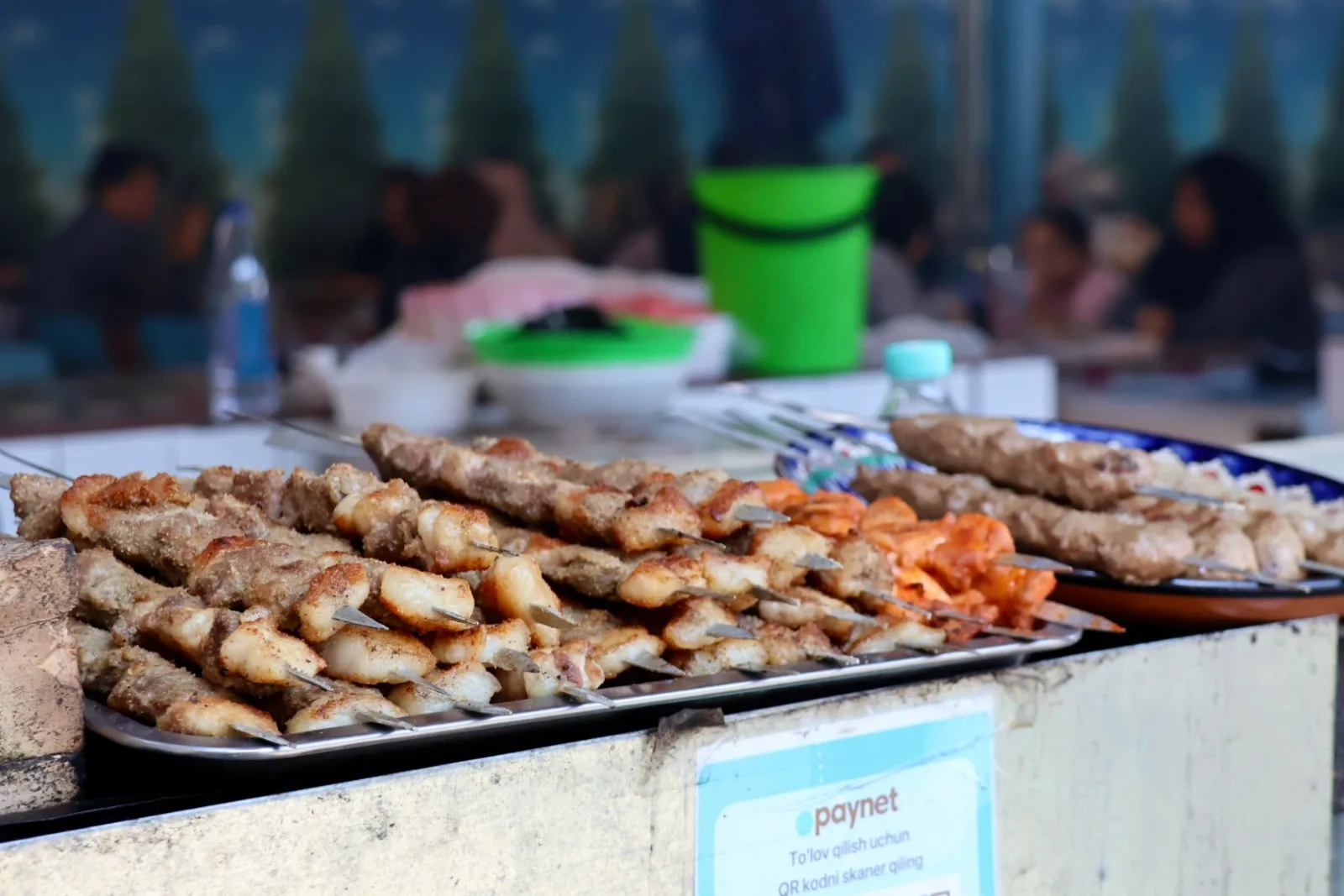
Uzbek shashlik isn't one dish — it's a family of grilling decisions built around fat ratio. The vendor working the lamb station alternated cubes of meat with cubes of pure tail fat, dumba, threaded every third or fourth piece onto the skewer. He explained, through our guide, that lean lamb alone burns dry on an open mangal; the fat renders and bastes the meat as it cooks, which is also why the coals flare unevenly and need constant small adjustments rather than one steady heat.
Marinade at this stall was minimal — onion, salt, black pepper, sometimes a splash of vinegar — rubbed in twenty minutes before grilling, not overnight. That surprised me. I'd expected an elaborate spice paste. The vendor's logic, relayed secondhand, was that a long marinade breaks down the meat's texture before the fire ever touches it, and a good cut of lamb doesn't need disguising. Two stalls down, a vendor working ground-meat lyulya kebab did the opposite — his mix included grated onion worked directly into the meat for moisture, a small amount of tail fat blended in rather than skewered separately, and no marinade at all because there was nothing solid left to marinate.
The mangal itself matters as much as the meat. Ours was a narrow steel trough, coals raked to different depths under different sections — deeper, hotter coals under the fat-marbled cubes that could take direct heat, a shallower bed under the leaner cuts. Watching him shift skewers from one zone to another mid-cook was the first time I understood shashlik as a technique rather than a recipe.
What It Actually Felt Like
I tried turning a skewer myself, under supervision, and got it wrong twice — too early the first time, so the fat hadn't rendered enough to stop it sticking to the grate; too late the second, so one side had gone past golden into a patch of char the vendor picked off before handing it back. He corrected my grip more than my timing, repositioning my hand closer to the far end of the skewer so the near end, closer to the hottest coals, could rotate freely without my wrist getting in the way.
The smell changes as the fat starts to render — a sharper, almost sweet edge over the char that isn't there in the first few minutes. I hadn't expected a street food demonstration to be a sensory education, but standing that close to the coals, hearing the fat hiss and drip, made it obvious why these vendors work the same stall for decades. The timing isn't written down anywhere. It's in the vendor's hands, in how long he holds a skewer before the next quarter-turn, and no amount of reading about Uzbek grilling prepares you for how fast those decisions actually happen.
Why the Small Group Size Matters
In a group of twenty, the vendor would have plated shashlik for photos and moved on to the next order. In our group of seven, he stopped mid-service to show us the fat-to-meat ratio on his own skewer before it went on the grill, then again once it came off, so we could see what had rendered out. That kind of unscripted, working-pace access disappears the moment a stall has to process a tour bus's worth of orders. Small groups don't just make the guide's job easier — they change what the vendor is willing to show you, because he isn't performing for a camera, he's doing his actual job while a handful of people happen to be watching closely.
What You Leave With
I left Chorsu with grilled lamb, my clothes carrying woodsmoke for the rest of the day, and a genuinely different sense of what "grilling meat" means when the fat ratio, the marinade timing, and the coal depth are all separate decisions a vendor is making in real time rather than following a fixed recipe. The knowledge isn't something I could write down and repeat at home with any confidence — it lives in the vendor's hands and the particular mangal he's worked for years, which is honestly the most convincing argument for going back and watching again rather than assuming one visit taught me the whole craft.
CraftNCulture's Chorsu Food Tour runs as a half-day route through the bazaar's grill and bread stalls; travelers who want a longer version can extend into the 4-Hour Food Tour & Metro Journey, which adds more stops and more time at each one. Both keep groups small enough that vendors talk rather than just serve.
CraftNCulture's Chorsu Food Tour — Tashkent, small groups, $65, 2 hours. The 4-Hour Food Tour & Metro Journey extends the same route with additional stops, $85.
About the author
CraftnCulture
The CraftnCulture editorial team — Tashkent-based cultural tourism specialists covering Uzbekistan travel, artisan crafts, and Silk Road heritage.