CraftnCulture
首页旅游线路工作坊巴扎集市相册博客Book Now
首页旅游线路工作坊巴扎集市相册博客Book Now我的账户
Language:

保持联系

订阅我们的新闻通讯,获取工作坊更新、文化见解和独家优惠。

CraftnCulture

通过亲身实践的工作坊和沉浸式多日游,探索正宗的中亚工艺。在乌兹别克斯坦与工艺大师建立联系。

探索

  • 工作坊
  • 乌兹别克斯坦旅游线路
  • 巴扎集市
  • 相册
  • 成为合作伙伴

资源

  • 旅行博客
  • 关于我们
  • 常见问题解答
  • 订单追踪
  • 联系我们

联系我们

  • Emailinfo@craftnculture.uz
  • Phone+998 90 272 01 13
  • WhatsApp+998 90 272 01 13
  • Studio乌兹别克斯坦塔什干
© 2026 CraftnCulture 版权所有隐私政策条款与条件
Home/Blog/History/Timurid Architecture: Inside Timur Empire's Artistic Legacy
History

Timurid Architecture: Inside Timur Empire's Artistic Legacy

Timurid architecture transformed Islamic design with soaring domes, glazed tilework, and bold scale. Discover the empire's enduring artistic legacy.

CraftnCulture EditorialJune 9, 20263 分钟阅读
Timurid Architecture: Inside Timur Empire's Artistic Legacy
本页内容▾
  1. The Empire That Built in Blue
  2. Hallmarks of Timurid Architectural Design
  3. Samarkand's Showpieces: Gur-e-Amir and the Registan
  4. Gur-e-Amir, the Prototype
  5. Bibi-Khanym and Ulugh Beg's Cosmos
  6. Why It Still Matters Today
  7. References

本页内容

  1. The Empire That Built in Blue
  2. Hallmarks of Timurid Architectural Design
  3. Samarkand's Showpieces: Gur-e-Amir and the Registan
  4. Gur-e-Amir, the Prototype
  5. Bibi-Khanym and Ulugh Beg's Cosmos
  6. Why It Still Matters Today
  7. References

Stand before the Registan in Samarkand at sunset, and you understand something words struggle to capture. The towering portals, the cobalt-and-turquoise tilework, the calligraphic ribbons that spiral toward heaven — this is Timurid architecture at full volume. Born of conquest and refined into one of the most ambitious aesthetic programs the Islamic world has ever known, it remains the visual signature of Uzbekistan's golden age.

The Empire That Built in Blue

Timur (Tamerlane) rose from the steppes of Transoxiana in the late 14th century to forge an empire stretching from Anatolia to the edges of India. While his military campaigns were brutal, his cultural ambition was equally intense. He imported the finest masons, woodcarvers, and tile-cutters from every conquered city — Damascus, Shiraz, Tabriz, Delhi — and concentrated their talents in his capital, Samarkand. The result was a synthesis: Persian proportion, Khorasanian decoration, and a Central Asian appetite for monumental scale. The Timur empire turned architecture into propaganda, and propaganda into beauty.

Hallmarks of Timurid Architectural Design

What makes a building "Timurid" rather than simply Islamic? A handful of features show up again and again across the empire's surviving monuments.

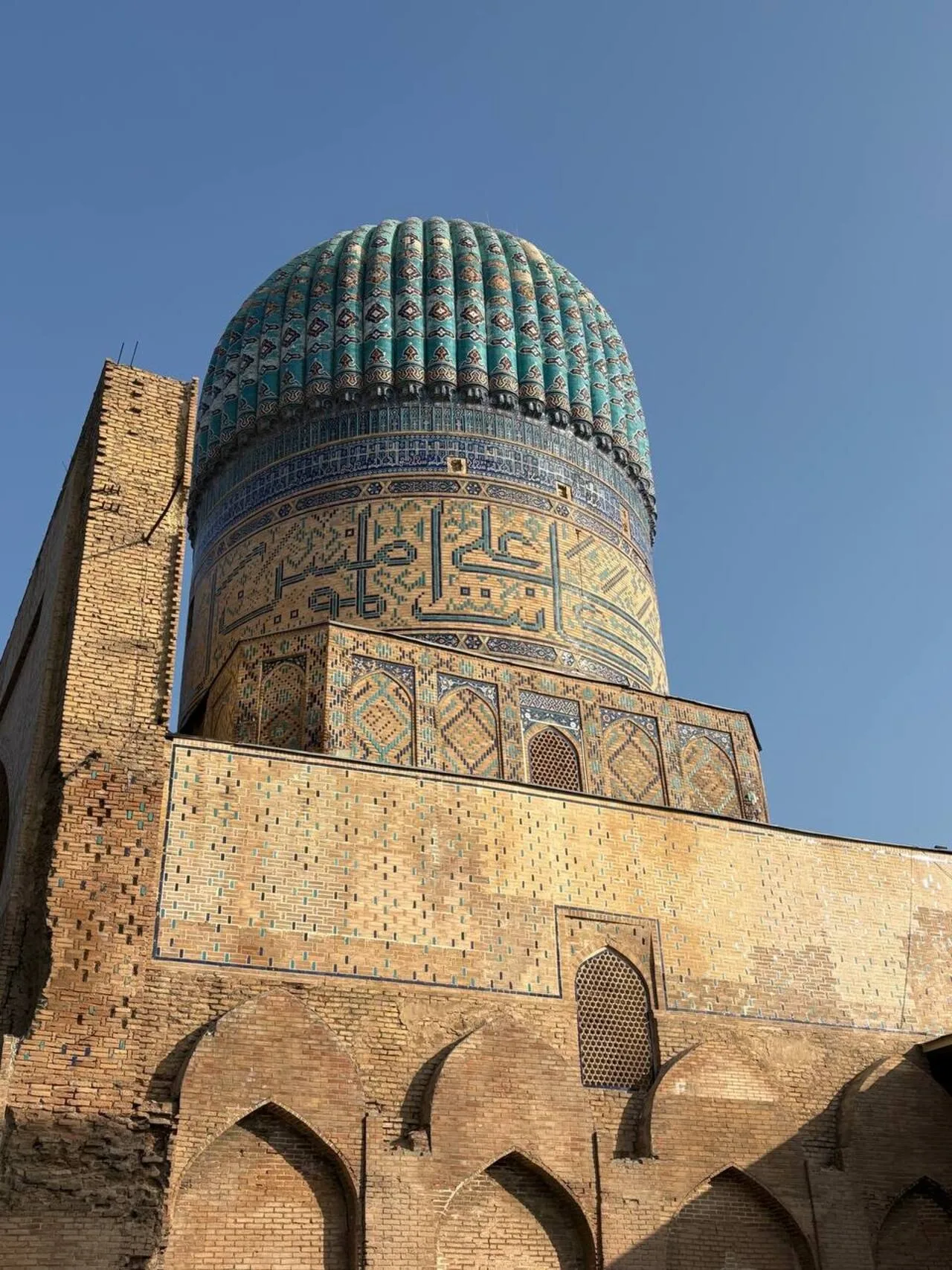
  • Bulbous double-shell domes that appear taller from outside than they read from within
  • Iwan portals — the towering, recessed entrance arches that frame courtyards
  • Geometric and floral tilework in cobalt blue, turquoise, and white, often in banna'i brick patterns
  • Muqarnas vaulting — honeycomb-like stalactite ceilings that catch light at every angle
  • Monumental scale designed to humble the visitor before the patron's vision

These elements crystallized into a coherent Islamic architectural design language that influenced Mughal India, Safavid Iran, and even Ottoman builders for the next two centuries.

Samarkand's Showpieces: Gur-e-Amir and the Registan

Two sites tell the story most clearly. Together they show how Timurid architecture moved from intimate mausoleum to public spectacle in less than a generation.

Gur-e-Amir, the Prototype

Timur's own mausoleum is where the style crystallizes. Its fluted, melon-shaped dome — ribbed in azure tile and rising on a tall drum — became a template the Mughals would later reinterpret at Humayun's Tomb and the Taj Mahal. Inside, slabs of dark jade mark the resting place of one of history's most consequential conquerors. The interior gilding remains breathtaking; the proportions feel surprisingly modern.

A short walk away, the Registan plaza takes the same visual language and scales it up to civic theater. Three madrasahs frame a single square, each built across two centuries yet speaking the same dialect. Ulugh Beg's madrasah (1420) is the scholarly elder, fronted by an iwan covered in star-pattern tilework. Sher-Dor (1636) breaks Islamic convention with famous tigers and human-faced suns. Tilya-Kori (1660) finishes the ensemble with a gold-leafed mihrab that glows like a furnace at midday.

Bibi-Khanym and Ulugh Beg's Cosmos

Near Samarkand's Siab Bazaar stands the ruined hulk of Bibi-Khanym Mosque, Timur's overreach in stone. He commissioned it to be the largest mosque in the Islamic world; the structure began collapsing within his lifetime. Yet even in ruin, its scale stops you mid-step. Nearby, his grandson Ulugh Beg built an observatory — a building disguised as a scientific instrument, with a 40-meter sextant carved into the bedrock. The Timurids were not just builders. They were measuring the heavens.

In Shakhrisabz, Timur's birthplace, the shattered Ak-Saray palace gates still rise nearly 40 meters, their tilework — what survives — among the finest in the empire.

Why It Still Matters Today

UNESCO has inscribed Samarkand, Bukhara, and Shakhrisabz as World Heritage Sites largely on the strength of their Timurid monuments. Conservation work continues — much of the tilework has been reset since Soviet-era restorations — but the bones are original. For travelers, designers, and art-history audiences, walking through these spaces is the closest thing to time travel architecture offers.

If you want to experience Timurid design beyond the photographs, CraftnCulture's heritage walking routes through Samarkand and Shakhrisabz pair monument visits with workshops where artisans still cut tile mosaic the way Timur's craftsmen did. It is one thing to admire a dome. It is another to watch a master fit the pieces that compose one.

References

  • UNESCO World Heritage: Samarkand – Crossroads of Cultures
  • UNESCO World Heritage: Shakhrisyabz Historic Centre
  • The Met: Timurid Period (1370–1507)
  • Lonely Planet: Samarkand
  • Britannica: Timurid Dynasty
timurid-architecturesamarkandislamic-designhistoryheritage

About the author

CraftnCulture Editorial

CraftnCulture Editorial contributes to the CraftnCulture journal, covering Uzbekistan's living craft traditions and Silk Road heritage.

与我们同行

Crafted in Uzbekistan: A 10-Day Cultural Workshop Journey through Uzbekistan

From $2150 per person

立即预订
本地贴士

日出后一小时再到访 —— 商贩更热情,光线更柔和,人群也尚未聚集。

相关故事

Bukhara Islamic Scholars: A Medieval Center of Learning
History

Bukhara Islamic Scholars: A Medieval Center of Learning

June 9, 2026
3 分钟阅读
Silk Road Uzbekistan: Ancient Trade Routes and Their Modern Revival
History

Silk Road Uzbekistan: Ancient Trade Routes and Their Modern Revival

May 1, 2026
3 分钟阅读
Silk Road History: Uzbekistan's Trading Legacy
History

Silk Road History: Uzbekistan's Trading Legacy

February 24, 2026
7 分钟阅读

亲身体验匠心工艺

加入我们在塔什干、撒马尔罕、布哈拉、希瓦及更多地区的精选行程与工作坊。

浏览行程

保持灵感

订阅我们的杂志,获取来自中亚的全新故事、旅行贴士与工艺师专访。

无垃圾邮件,随时可取消订阅。