The felt was still damp when Aigul handed it to me, and it weighed more than I expected. Not heavy exactly — dense. Compressed. Three hours of rolling wet wool in soap water had turned loose fiber into something with structure, something that would hold a shape for decades if you let it. I'd come to Uzbekistan thinking I understood textiles here meant one thing: ikat, the tie-dyed silk everyone photographs in Margilan. I left three workshops later knowing that was maybe a third of the story.
That's really the case for this kind of Central Asian textile traditions trip: no single craft explains the others. Felt is nomadic — Steppe technology, made without a loom, portable, functional before it's decorative. Suzani is domestic — stitched by women for their own households, dowries, weddings. Ikat is commercial — historically a market craft, produced for trade along the Silk Road, requiring capital (a loom, dyes, time) that felt and embroidery don't. Understanding why they're different told me more than any single deep-dive would have.
The felt workshop: Steppe technology, not decoration
Aigul's family has made felt for at least three generations, though she was careful to say "at least" — record-keeping this far back is oral, not documented. We started with raw wool, unwashed, still smelling faintly of lanolin and the sheep it came from. Laying it out in even layers took longer than I expected; uneven thickness means weak spots that tear later; she checked mine twice and adjusted it once without commentary, just moving my hands to where the wool was thin.
Then the water, the soap, and the rolling — wrapping the wet wool around a reed mat and rolling it, over and over, for close to two hours, occasionally unrolling to check how the fibers were matting together. My shoulders ached by the halfway point. This is not a craft that photographs well mid-process; it's repetitive, physical, and the transformation is invisible until it suddenly isn't. Somewhere in that second hour, loose fiber became fabric, and I couldn't tell you the exact moment it happened.
The suzani workshop: what gets stitched and why
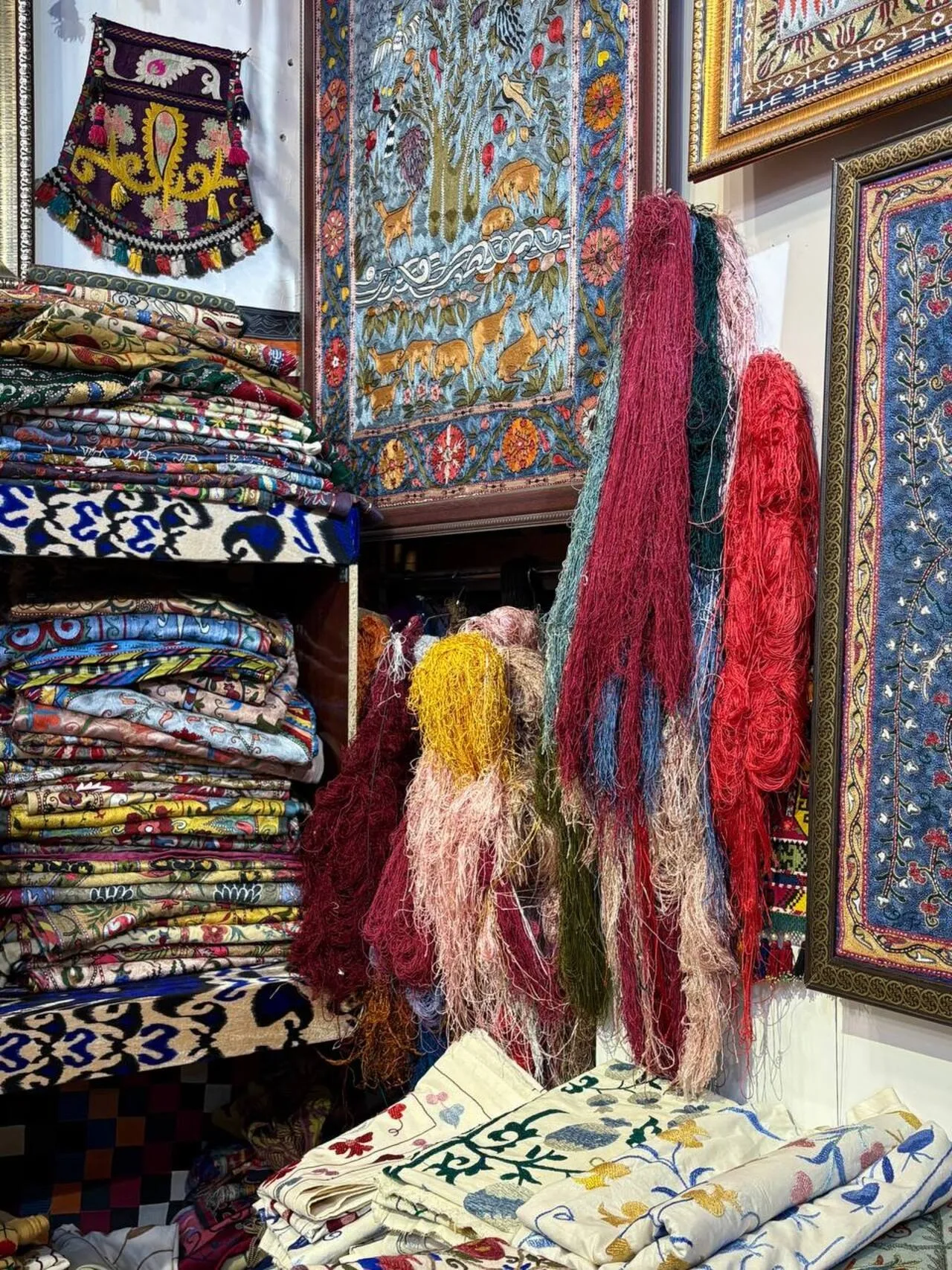
Two days later, in a cooperative workshop outside Kokand, six women sat around a stretched cotton panel, each working a different section of the same design. This is not solitary handwork — suzani is often a shared, social craft, and the cooperative's system reflects that: each woman specializes in certain motifs (pomegranates, tulips, the sun-disk patterns) and moves between panels rather than one person finishing one piece start to finish.
I was given a corner section, already outlined, and told to fill it with a chain stitch. My stitches were visibly looser than the women's on either side of me — theirs were even, tensioned the same way stitch after stitch; mine varied, tight in some places, loose in others, in a way that made the thread pucker slightly. Nobody corrected me outright. One of the women simply reached over, unpicked four stitches, and redid them slower, close enough for me to watch the tension in her hands. That's the whole lesson, delivered without a word.
The weaving workshop: what commercial ikat actually costs
By the time I reached the ikat workshop in Margilan, I'd stopped assuming this would be the highlight, and that turned out to be the right instinct — it was the most process-heavy of the three, and the least immediately satisfying to do by hand. Tying off sections of thread before dyeing, to resist the dye and create the pattern, requires the kind of precision that takes years to get fast at; I spent forty minutes tying resist-knots for a pattern the workshop's master ties in under ten. The loom work afterward was almost a relief by comparison — mechanical, repetitive, at least visibly productive stitch by stitch.
What struck me here wasn't the craft itself so much as the economics underneath it. Ikat requires a loom (a real capital investment), dye materials often sourced regionally, and enough production volume to be worth setting up at all. Felt and suzani can be made by one family with minimal equipment. Ikat, historically, was made to sell.
Why the small group mattered
Eight people, split across three different workshops over six days, meant each artisan was teaching, not performing. In a group of twenty at the felt workshop, Aigul would have demonstrated once and let people copy from a distance; in a group of eight, she corrected hands individually. The suzani cooperative doesn't have space for a large tour group to begin with — six or seven people fit around the stretched panel, which is presumably part of why CraftNCulture caps this route where it does.
What you leave with
I left with felt I made myself (uneven at the edges, structurally sound in the middle), a suzani corner section I'll probably never finish alone, and the beginning of an understanding of ikat's resist-tying that took me most of an afternoon to barely start grasping. My hands smelled like wet wool for two days afterward. There's a small dye stain on my left thumb from the ikat workshop that took a week to fully fade.
What I actually took away wasn't a finished object — it was a rough map of how three textile traditions in the same country solve different problems: portability, domestic meaning, and trade value. That's not a claim any single-craft workshop could make on its own, and it's the reason to do the comparative version instead of picking just one.
Tour details: Six-day Central Asia textile traditions route (felt-making, suzani embroidery, ikat weaving) · Small groups, max 8 · Contact CraftNCulture for current dates and pricing.
About the author
CraftnCulture
The CraftnCulture editorial team — Tashkent-based cultural tourism specialists covering Uzbekistan travel, artisan crafts, and Silk Road heritage.