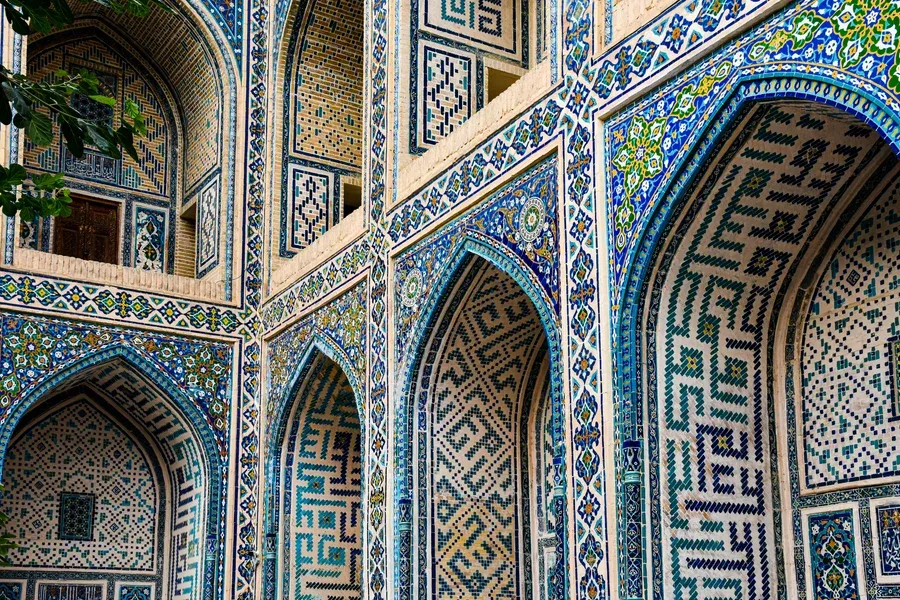
Everyone arrives in Samarkand for the Registan. Three towering madrasas, blue-tiled façades, the obligatory sunset photograph. But spend a single afternoon walking outward from that famous square, and you'll discover a different city — one where 14th-century mausoleums sit on quiet hillsides, where Timurid astronomers measured the cosmos, and where lesser-known shrines still hum with daily life. This Samarkand itinerary leans into the hidden gems most tourists rush past.
Bibi-Khanym Mausoleum: The Forgotten Tomb
Most visitors photograph the Bibi-Khanym Mosque next door and never cross the small lane to the Bibi-Khanym Mausoleum. That's a mistake. Built in the late 14th century, this small octagonal structure is believed to hold the remains of Timur's mother-in-law and several Timurid women. The crypt below — accessible by a narrow staircase — preserves original carved-stone sarcophagi that survived centuries of earthquakes and Soviet neglect. There are no crowds here. Often you'll have the entire space to yourself, a rare privilege at a UNESCO World Heritage site.
Ulugh Beg's Observatory: Where Stars Met Science
Two kilometres northeast of the Registan, on Kuhak Hill, sits one of the most underrated sites in Uzbekistan. In the 1420s, Timur's grandson Ulugh Beg — astronomer-king before he was anything else — built a three-story observatory with a 40-metre marble sextant carved into the bedrock. His star catalogue, published in 1437, was so accurate that European astronomers were still consulting it 250 years later. The above-ground structure was destroyed in 1449, but the buried lower section of the sextant was rediscovered in 1908 and is now displayed under a small museum.
How to Get There
A short taxi ride from the city centre is easiest, but the No. 99 marshrutka stops at the foot of the hill. Pair the visit with the Hazrati Khizr Mosque on the way back; both are quieter in the morning.
Shah-i-Zinda's Quieter Corners
Shah-i-Zinda is famous, of course, but most tour groups walk only the central avenue of mausoleums and leave. Climb the back staircase past the Tuman Aka complex and you'll reach a small upper terrace with views over the old necropolis and the Russian-era cemetery beyond. Local pilgrims often pray here in the late afternoon. The carved stucco and majolica tilework on the smaller, peripheral tombs is sometimes more refined than on the headline pieces — it simply doesn't get the foot traffic.
Khoja Daniyar Mausoleum and the Living Tree
On the bank of the Siab River, an 18-metre-long tomb is said to contain the remains of the Old Testament prophet Daniel — relics reputedly brought from Susa by Timur himself. The structure carries a strange legend: the body inside is said to grow, requiring extensions to the sarcophagus over the centuries. Outside, an ancient pistachio tree declared dead in the 1990s mysteriously regrew after a visit by a religious leader. Believe what you want; it remains a deeply atmospheric corner of Samarkand that almost no tour itinerary includes.
Building a 2-Day Samarkand Itinerary
If you want to combine the famous monuments with these hidden gems, plan in pairings rather than checklists. A workable two-day rhythm looks like this:
- Day 1 morning: Registan Square at opening, then Bibi-Khanym Mausoleum
- Day 1 afternoon: Shah-i-Zinda — go in the heat of midday when groups thin out
- Day 2 morning: Ulugh Beg's Observatory and the Afrasiab Museum nearby
- Day 2 afternoon: Khoja Daniyar, then a slow walk through the Siab Bazaar
- Either evening: chaikhana tea on Tashkent Street with locals
Skip the temptation to add Shahrisabz as a day trip — you'll spend more time in cars than at sites and miss the texture of Samarkand itself.
Samarkand rewards travellers who slow down. CraftnCulture's small-group itineraries are designed around exactly this kind of layered visit — pairing the world-famous monuments with the quiet shrines, ceramic workshops, and family-run chaikhanas where the city actually breathes. Whether you build your own trip or join one of ours, give Samarkand more than 24 hours. The Registan will still be there. So will the rest.
References
About the author
CraftnCulture
The CraftnCulture editorial team — Tashkent-based cultural tourism specialists covering Uzbekistan travel, artisan crafts, and Silk Road heritage.