Kyzylkum Desert Travel: What Three Nights With Nomadic Herders Actually Feels Like
The generator cut out around nine. Not a big deal — the herder family we were staying with hadn't been running it for entertainment anyway, just to charge two phones and keep a bulb over the tea table lit until the last guest went to bed. After that, the dark came in fast and complete, the kind you don't get within four hundred kilometers of Tashkent, and somebody's grandmother kept talking in Karakalpak while pouring green tea by feel, not by sight.
I'd signed up expecting scenery. What I got was three days of realizing how much of "nomadic culture experiences" advertising is really just a photo of a yurt at sunset, and how little of it tells you that a desert crossing with a herding family is mostly logistics — where the sheep drink, which dune face holds shade past noon, how far the nearest well actually is versus how far the map says it is.
How I got here
The Kyzylkum isn't a stop on most Uzbekistan itineraries. It sits between Bukhara and Nukus, a red-sand expanse the guidebooks mention mostly as something you fly over. I'd done the craft-workshop circuit in Bukhara the week before — gold embroidery, a knife-making session with a coppersmith who corrected my grip more than my cuts — and wanted something that wasn't a city stop. A guide in Bukhara connected me to a small operator running desert homestays with an actual herding family near the Kyzylkum's southern edge, not a staged "nomad camp" built for tour buses. Four of us went. That was the whole group.
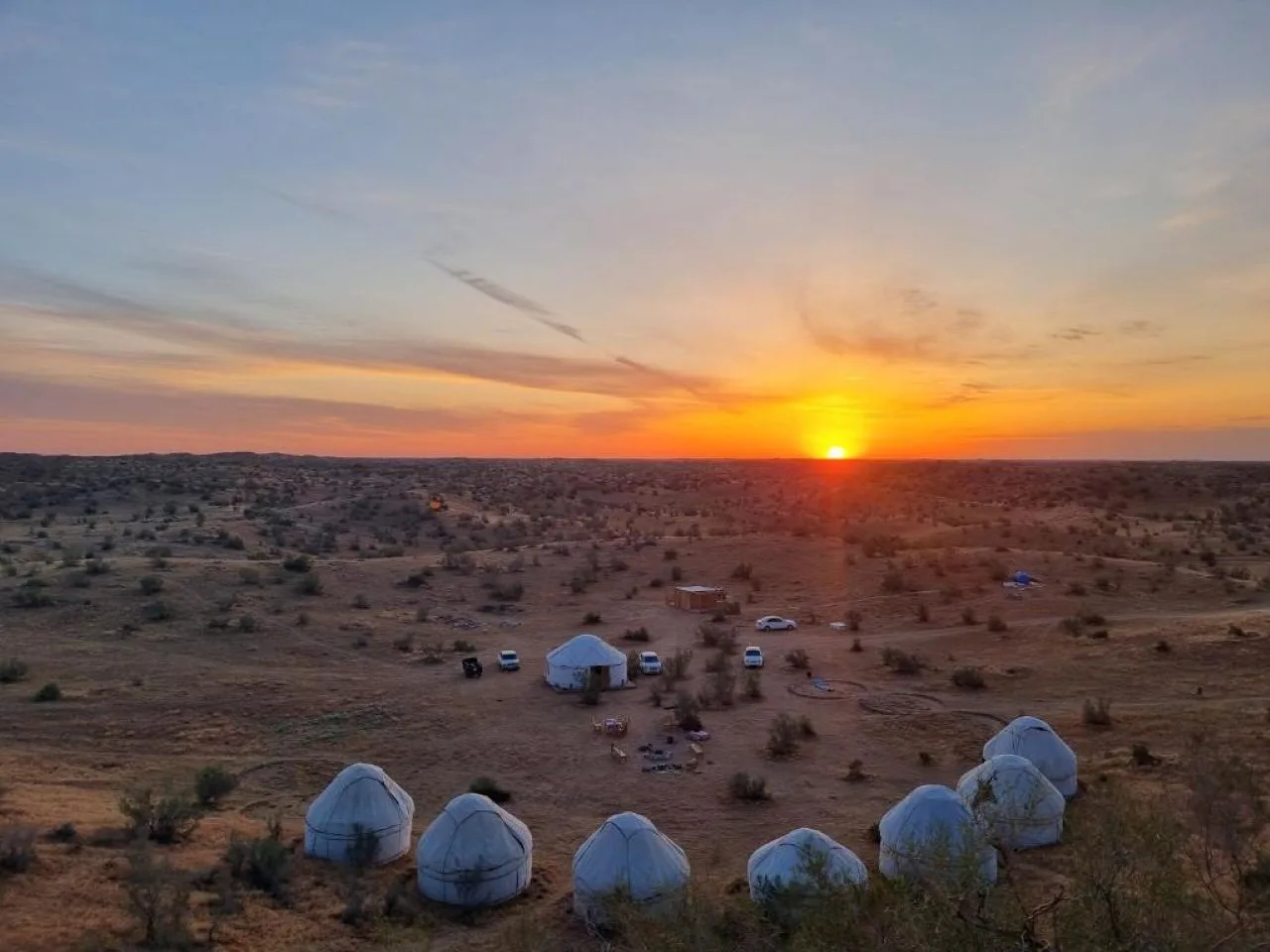
Desert camping in the Kyzylkum turns out to mean something more specific than the phrase suggests: not a tent pitched anywhere scenic, but a fixed seasonal camp the family has used for generations, moved twice a year with the grazing. We slept in a felt yurt that smelled like lanolin and woodsmoke, on bedding that had clearly hosted more sheep-related work than tourists.
What the herding actually involves
Ergash, the family's eldest son, ran the mornings. Up before light, out with the flock by six, back by ten before the heat made grazing pointless. He let me walk with him the second day — not herd, walk near — and the thing that surprised me wasn't the distance, it was the attention. He wasn't looking at the sheep so much as at the ground: which plants they'd already stripped, which dune had held rain three weeks back and would still have green shoots underneath the sand crust. None of that is written down anywhere. It's a map that exists only in his head and his father's, and increasingly not in his younger cousins', who've mostly moved to Nukus for work.
That's the part the marketing language skips. This isn't a demonstration of "traditional nomadic life" performed for visitors. It's an actual, functioning, economically marginal way of raising livestock that a handful of families in this stretch of the Kyzylkum still practice, and that is visibly thinning by generation. Ergash was blunt about it over dinner: his own kids, he said, probably wouldn't do this. He wasn't sentimental about it. It's simply hard, and there's easier money in the city.
What it actually felt like
The heat during the day was manageable — dry, and we weren't the ones working. The cold at night wasn't something I'd prepared for; desert nights in the Kyzylkum drop harder than you'd expect from daytime highs, and the felt walls of the yurt only do so much. I woke twice the first night from cold, not romance.
The food was plain and repetitive in a way I found more honest than most "authentic cuisine" framing bothers to admit — flatbread, a milk-tea called shubat some mornings, a mutton stew heavy on onion the second night. Nobody performed hospitality theater. The family fed us because that's what you do with guests, and the meal didn't slow down or speed up because we were there.
Silence is the thing I keep coming back to. Not silence as in "peaceful" — silence as in an absence you have to sit inside of, because there's no ambient hum to distract from it, and by the second night I found it genuinely uncomfortable before it became something closer to restful. That's not a sensation a two-hour desert excursion from a resort gives you. It takes at least one full night without a generator running to get there.
Why the small group mattered
There were four of us, which meant we ate at the same low table as the family rather than at a separate one set up for guests. In a larger group — the kind some operators run, fifteen or twenty people bused out for an overnight — that table gets split, translation gets funneled through one guide instead of happening directly, and Ergash's attention gets spread thin enough that nobody actually walks with him in the morning. With four, there was room for him to answer a genuinely dumb question about why he'd stopped at one particular dune, and to actually answer it rather than give the shortened tour-guide version.
What you leave with
Not much, physically — a fine layer of red dust that stayed in my bag's seams for a week, and a sunburn line where my scarf had slipped. What stuck was less tangible and, honestly, a little uncomfortable to sit with: the knowledge that this specific version of desert life is a live, working thing right now, not a preserved one, and that it's plausible it won't be practiced by Ergash's generation's children at all. I didn't leave with a souvenir. I left with a fairly specific, unglamorous picture of what "nomadic culture" means when it isn't staged for a camera.
CraftNCulture doesn't currently run a standalone desert-camping product — this trip was arranged through a small independent operator connected via a Bukhara-based guide, not a CraftNCulture booking. If the Kyzylkum interests you as an add-on to a craft-focused trip, the closest fit on CraftNCulture's own roster is the Bukhara-based workshop circuit — the gold zardozlik embroidery session and the knife-making workshop in the Old Town — which pair naturally with a few extra days arranged locally toward the desert's southern edge. For a broader Central Asia itinerary that includes nomadic heritage without the logistics of arranging an independent homestay, CraftNCulture's 7-day Living Traditions of the Silk Road tour touches craft communities across three cities and can be extended informally with local operators for travelers who want the desert leg tacked on.
Trip arranged independently via a Bukhara-based guide connection; not a CraftNCulture-operated product as of this writing. CraftNCulture's Bukhara workshop circuit (gold embroidery, knife-making) and the 7-day Living Traditions of the Silk Road tour are the closest matches on the current CraftNCulture roster for travelers wanting to combine craft workshops with a Kyzylkum extension.
About the author
CraftnCulture
The CraftnCulture editorial team — Tashkent-based cultural tourism specialists covering Uzbekistan travel, artisan crafts, and Silk Road heritage.