The needle was heavier than I expected.
Not the sewing-kit kind — this one had weight to it, a proper heft, and the thread it carried wasn't thread at all. It was a flat gold cord, almost a ribbon, caught between the tip and the fabric in a way that I immediately understood I would get wrong. Several times. Which I did.
I was sitting in a workshop in Bukhara's old city, a room so low-ceilinged and piled with finished panels that the gold seemed to be growing out of every surface. Bakshillo gestured for me to sit across from him, adjusted the frame between us, and pressed the needle into my palm without ceremony. He didn't speak much English. He didn't need to.
How I Got Here
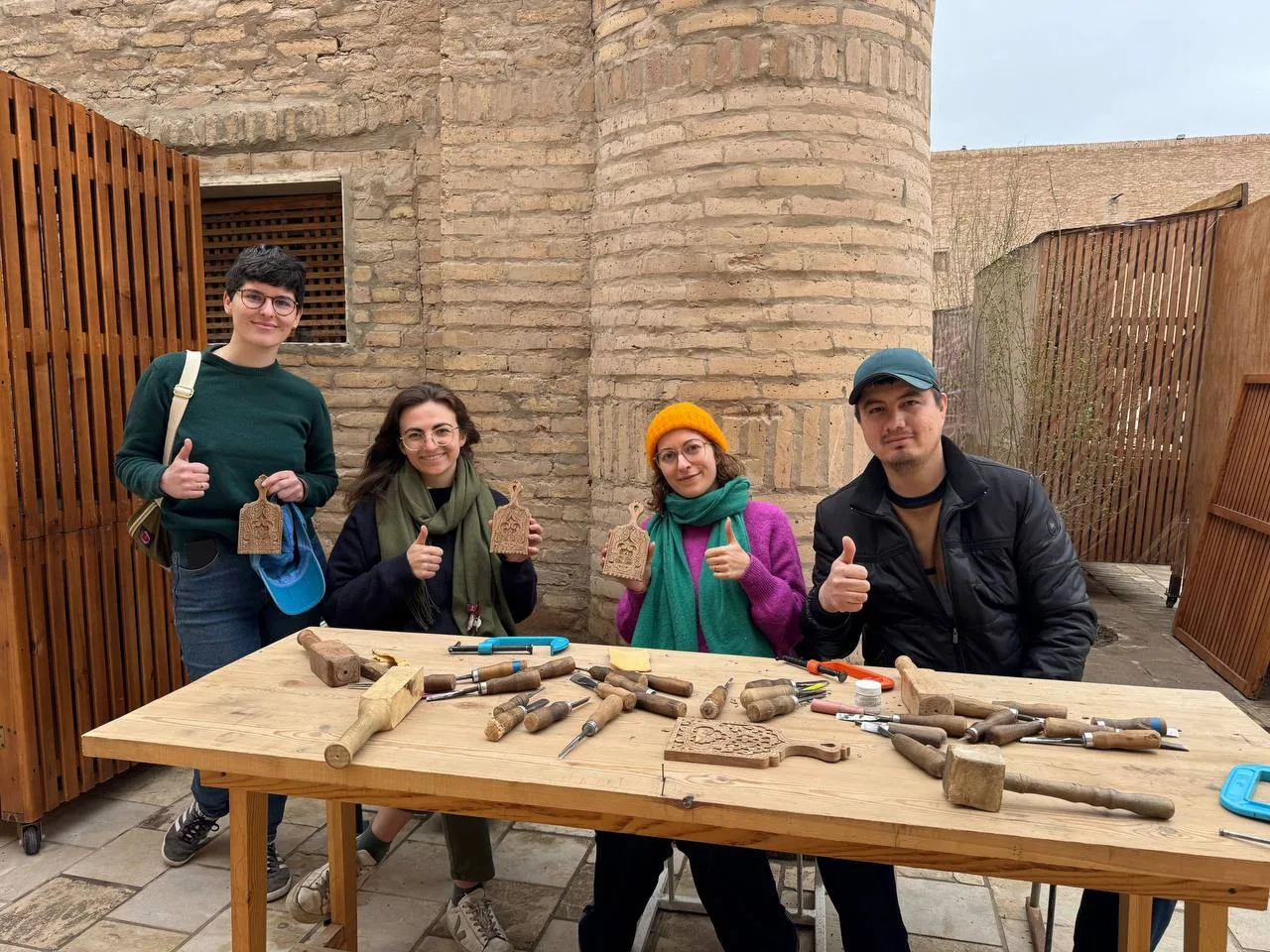
I arrived in Bukhara on the fourth day of a small-group cultural craft tour of Uzbekistan — eight of us total, traveling with CraftnCulture from Tashkent through Samarkand and then here. The group was small by design, not by accident. You can't do what we were doing — sit inside a working studio, take up a master's time, actually touch the materials — if there are twenty of you. Eight people is the kind of number where the master can watch your hands. Where you can ask the stupid question. Where it doesn't feel like a demonstration.
I'd signed up because I wanted something beyond monuments. Every travel article about Uzbekistan spends three paragraphs on Registan, which is extraordinary, yes — but I didn't fly to Central Asia to photograph something I'd already seen in a hundred other photographs. I came because I wanted to understand how this place makes things. What it's like inside the rooms where the beauty is actually produced.
Gold embroidery — zardozlik in Uzbek — was not something I knew I needed to see until I saw it.
The Craft Itself
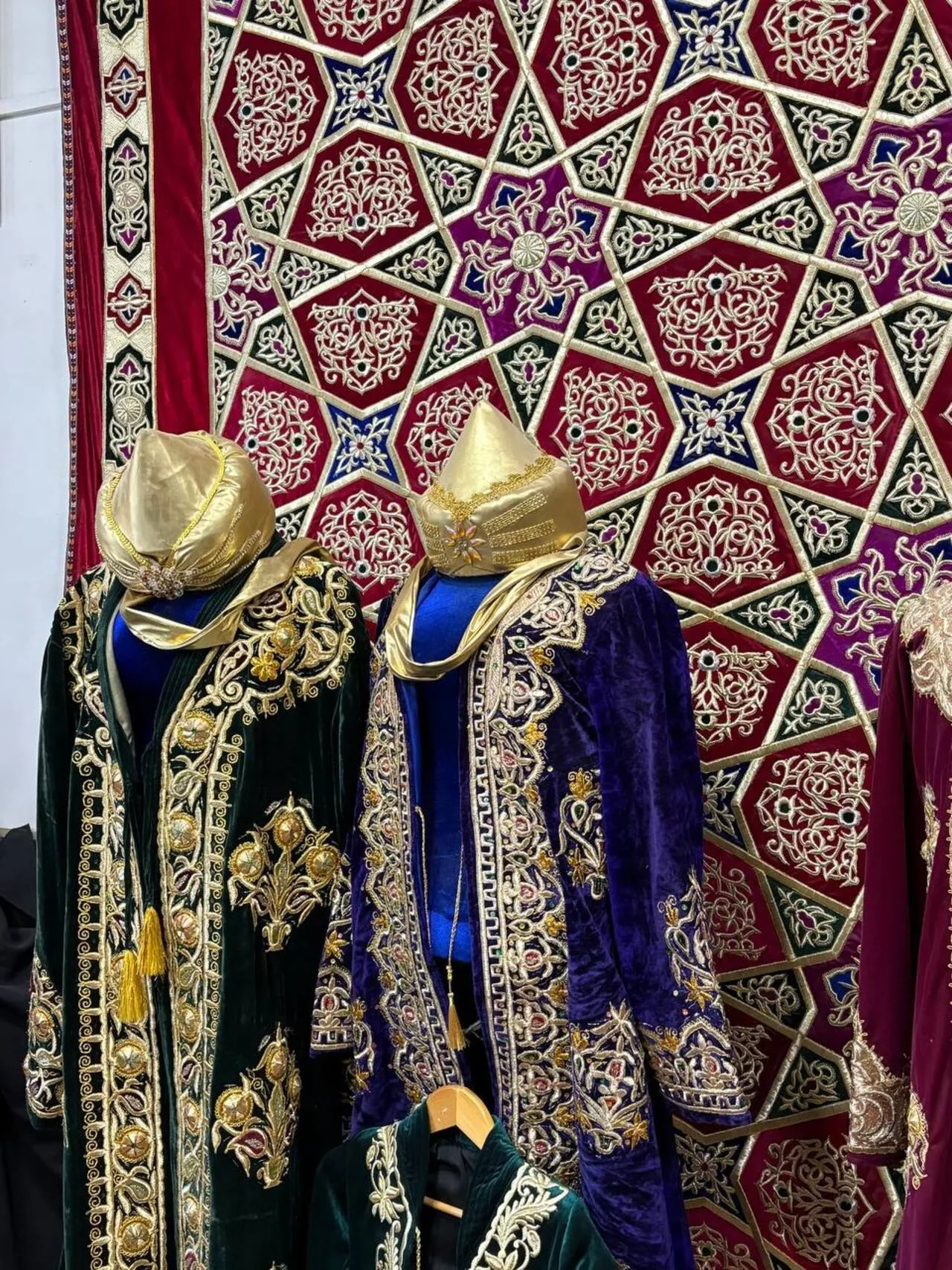
Bukhara has been the center of gold embroidery on the Silk Road for centuries. The technique involves couching metallic thread — flat, twisted, or corded gold and silver — onto velvet or silk using tiny, almost invisible stitches. You don't push the gold thread through the fabric. You lay it on the surface and anchor it, millimeter by millimeter, with a second thread below. The result is this raised, almost three-dimensional quality that catches light differently depending on angle. You've seen it on royal robes and ceremonial hangings in museums without knowing the name for it.
Bakshillo had been practicing this craft for decades. The speed at which he worked was mildly humiliating to watch.
When it was my turn, I understood immediately that what looks like patience from the outside is actually precision. There's no winging it — the angle of the needle, the tension of the anchoring thread, the way the gold cord has to lie flat or it bunches. I made about four centimeters of a simple scrolling vine motif in the time he completed a full palmette the size of my hand. My four centimeters were uneven. One section puckered. The gold cord at the end curled up slightly, which apparently means I held too much tension in my wrist.
Bakshillo reached over, didn't say anything, and showed me with his hand on mine. The correction was instant, physical, and completely impossible to communicate any other way. That's the thing about craft workshops that no video tutorial prepares you for: the knowledge lives in the muscle, not the instruction.
What It Actually Felt Like
I want to be honest here: you won't produce anything good in two hours. That's not what this is. What you will do is develop a sudden and total respect for every gold-embroidered piece you've ever seen — in a museum, in a souvenir shop, folded under glass. You'll stop seeing "decorative textile" and start seeing years of someone's hands.
There was a panel on the wall behind Bakshillo that had been commissioned for a wedding. It was roughly a meter square, and he'd been working on it for three weeks. I looked at it differently after I'd held the needle for twenty minutes.
The other thing that happens — and I didn't expect this — is that it slows you down in a useful way. The old city hummed outside. Blue domes, trading domes, the smell of dried fruit from a stall somewhere around the corner. Inside, just the sound of thread and frame and occasional quiet instruction. There's a meditative quality that I can only describe as the opposite of tourism.
Why the Small Group Size Matters
There were seven of us learning that afternoon. One pair of Americans who kept sharing each other's progress like it was a competition. A solo traveler from Japan who barely looked up once she got going. Me. We each had our own frame, our own materials, our own version of Bakshillo watching our hands.
In a group of twenty, he would have been performing. In a group of eight on a cultural craft tour of Uzbekistan built for exactly this, he was teaching.
That distinction is everything.
What I Took Home
A small embroidered fragment, imperfect enough to be distinctly mine, wrapped in paper. The knowledge that zardozlik is not decorative — it's documentary. The motifs encode meaning: pomegranates for fertility, vines for connection, birds for freedom. And a quiet certainty that I want to come back, spend a week, and get good enough for the puckering to stop.
The CraftnCulture 7-day journey through Uzbekistan includes this session in Bukhara alongside ceramics, carpet-making, miniature painting, and more — always with working artisans, never more than eight guests. From $1,850 per person.
That's not a package tour. That's an education.
CraftNCulture runs small-group cultural craft tours across Uzbekistan. Upcoming departures: September–October 2026.
About the author
CraftnCulture
The CraftnCulture editorial team — Tashkent-based cultural tourism specialists covering Uzbekistan travel, artisan crafts, and Silk Road heritage.