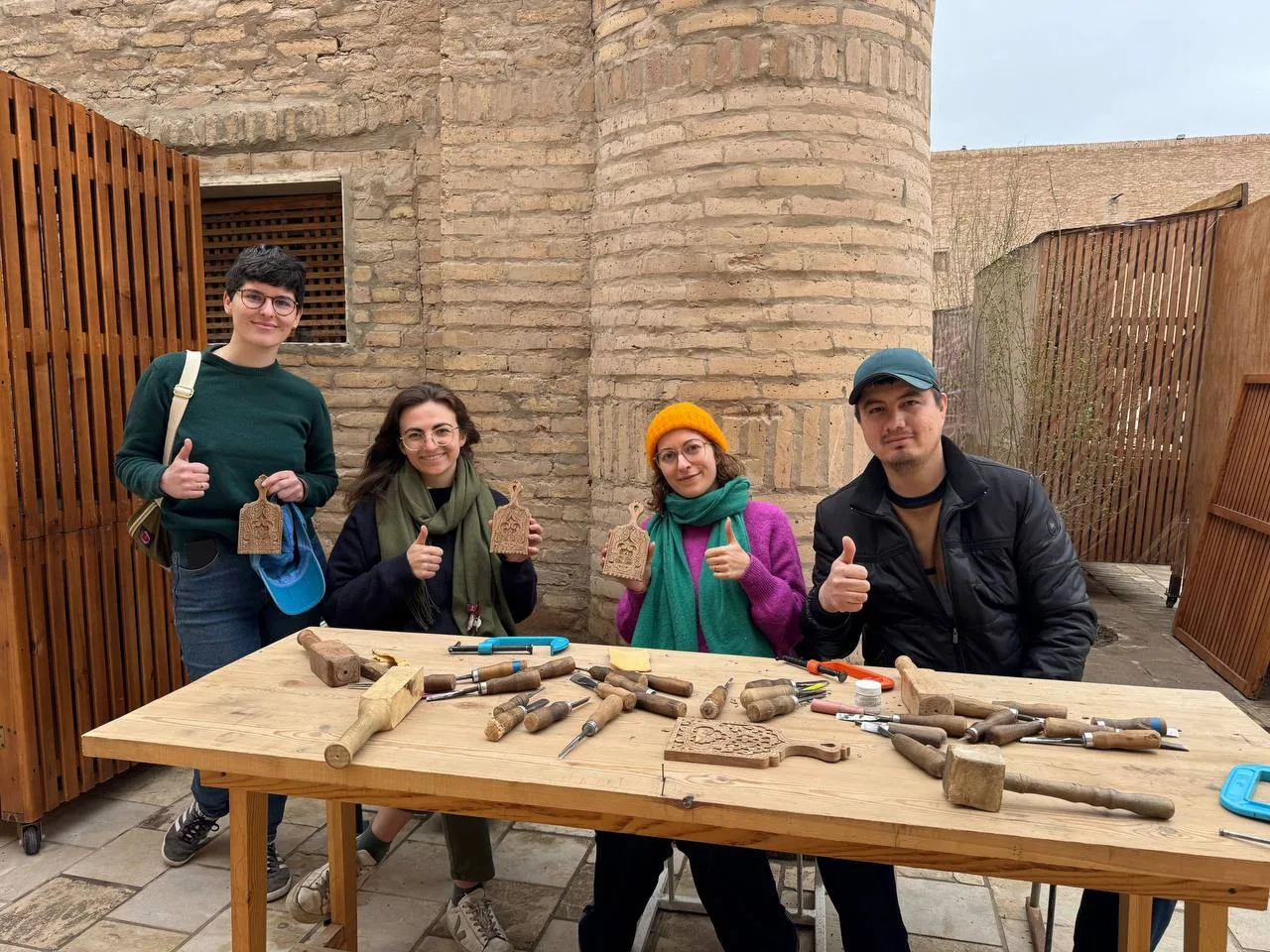
The chisel was lighter than I expected. The walnut block clamped to the bench was not. Every time I pushed, the wood pushed back, and after twenty minutes my forearm ached in a place I didn't know could ache.
How I Ended Up Carving in Ichan-Kala
I'd come to Khiva expecting to look at things, not make them. The old town — Ichan-Kala, the walled inner city that UNESCO listed as a World Heritage Site in 1990 — is usually a place you photograph: blue-tiled minarets, mudbrick walls, madrasah courtyards empty of everything except tour groups moving in loose clumps from gate to gate. I'd done two days of that already, and it was fine, but it was starting to feel like visiting a very well-preserved stage set.
Then a guide mentioned there was a wood carving workshop still operating inside the walls — not a demonstration booth set up for tourists, but a working shop that happened to also teach a small group of visitors a few hours a week. That distinction mattered to me more than I expected it to. A cultural craft tour of Uzbekistan can mean a lot of different things; I wanted the version where the craft was still real work, not a performance staged around my visa dates.
The shop sits a few minutes' walk from the Kalta Minor, in one of the narrow lanes that Ichan-Kala's daytime crowds mostly skip. Inside, it smelled like sawdust and something resinous — walnut oil, I found out later, rubbed into finished panels to bring out the grain. Wood shavings covered the floor in a way that made it obvious nobody had cleaned up for my benefit.
What Khiva Wood Carving Actually Is
Khiva's carving tradition is built almost entirely around walnut — a dense, dark wood that was historically the only material considered worthy of a merchant's front door or a khan's column. You see it everywhere in Ichan-Kala if you know to look: the carved wooden columns of the Juma Mosque, some of them centuries old, load-bearing and decorative at once. The patterns aren't random. Geometric interlace, stylized vine and pomegranate motifs, sometimes a band of calligraphy along a lintel — each element has a name and a place in a visual vocabulary that carvers here have been passing down since before the khanate.
What surprised me was how little of it is drawn first. The artisan running the session sketched a rough guide line in pencil, then worked almost entirely by eye and muscle memory from there — checking the angle of a cut against the light, correcting with a shift of wrist pressure rather than a ruler. He explained, through the guide translating, that a design gets simpler to draw and harder to cut as you go deeper into the tradition — the goal isn't precision copied from paper, it's proportion held in the hand.
What It Actually Felt Like
I was given a small rectangular panel, already roughed out with the outline of a simple geometric border, and told to deepen one repeating motif. It took me most of the two hours to do what he demonstrated in about four minutes.
The hardest part wasn't the carving motion itself — it was reading the wood grain before you cut, which nobody can really teach you except by making you cut against the grain once so you feel the blade catch and skid. Mine skidded twice. The second time it took a visible chip out of the edge I was supposed to be squaring off, and he came over, looked at it for a second, turned the panel forty-five degrees without a word, and showed me how to angle my next pass to carve the chip into part of the pattern instead of sanding it out. That's not a technique you find in a how-to article. It's the kind of correction that only exists because a real carver was standing over real, imperfect wood.
By the end my motif was uneven — visibly so, the depth shallower on one side than the other — but it was mine, cut by hand from a block that started as nothing.
Why the Small Group Mattered
There were five of us in the session. I watched him correct someone else's cut with the same forty-five-degree turn, then come back to check on mine less than ten minutes later. In a demonstration booth built for tour buses, that kind of individual correction doesn't happen — you get shown the technique once, from a distance, and then you're on your own with a pre-cut souvenir kit. Here, the group was small enough that he was actually teaching five separate problems, not performing one routine five times.
What I Left With
I left with the panel, a raw, uneven thing I still keep on a shelf, and a sore forearm that lasted two days. More than that, I left understanding something about Ichan-Kala I hadn't gotten from two days of walking past its carved doors and columns: that the wood carving covering half the old town's architecture wasn't installed by some vanished medieval workforce. It's a living, single-lineage skill, and as of this year, Khiva has exactly one standing workshop still teaching it to outsiders — which is a smaller number than it should be for a UNESCO site built almost entirely from carved walnut.
CraftNCulture runs this as the Khiva: Wood Carving Workshop Inside the UNESCO Site Old Town, a two-hour, small-group session for $55 per person, and it also anchors two days of the Crafted in Khiva tour for travelers who want the old town's other crafts alongside it. Book either through CraftNCulture's small-group cultural craft tours of Uzbekistan — five people to a bench, one carver's real, working hands to learn from.
About the author
CraftnCulture
The CraftnCulture editorial team — Tashkent-based cultural tourism specialists covering Uzbekistan travel, artisan crafts, and Silk Road heritage.