Seven days, three cities, and by day four the itinerary stops looking like a spreadsheet and starts looking like a route you actually remember: dust on your shoes from a madrasah courtyard, a blister from the loom pedal, a phone full of photos you'll never sort. This is what a realistic 7-day Uzbekistan itinerary actually looks like when you build it around Tashkent, Samarkand, and Bukhara — not around what fits neatly into a brochure.
How I got here
I'd read three different "best Uzbekistan itinerary" posts before booking, and all three disagreed with each other on nearly everything except the three cities. One wanted me to spend a single night in each place. Another had me doing Samarkand as a day trip from Tashkent — four hours each way on top of the sightseeing, which sounded less like travel and more like an endurance event. I ended up booking CraftNCulture's 7-day Living Traditions of the Silk Road tour, mostly because it was the only one that admitted, up front, that you can't do this properly in less time. Eight people in the group, one guide, no bus with forty tourists filing off it at every stop.
Why seven days, not five
Five days gets you the monuments. Seven days gets you the monuments plus enough slack to actually sit down with someone who makes things for a living. That's the real difference, and it's not subtle once you're there — the itinerary blocks out actual working hours with an artisan, not a fifteen-minute photo stop at a workshop door. Cut it to five and the two craft sessions are the first things to go, because they take the longest and photograph the worst mid-process (nobody's suzani stitching looks impressive at minute twelve).
The itinerary, day by day
Day one is Tashkent — arrival, a walk through the old city, and a first pottery session at a hands-on ceramics workshop that exists specifically to get your hands dirty before you've adjusted to the time zone. Nobody's precious about a wobbly first bowl.
Days two and three move to Samarkand. Registan Square in the morning light, before the tour groups arrive, then an afternoon with a gold embroidery artisan who works from a converted front room, not a shop built for visitors. The needle for zardozlik work is heavier than a regular sewing needle — it has to be, to push gold thread through layered fabric — and nobody warns you about that until you're holding it.
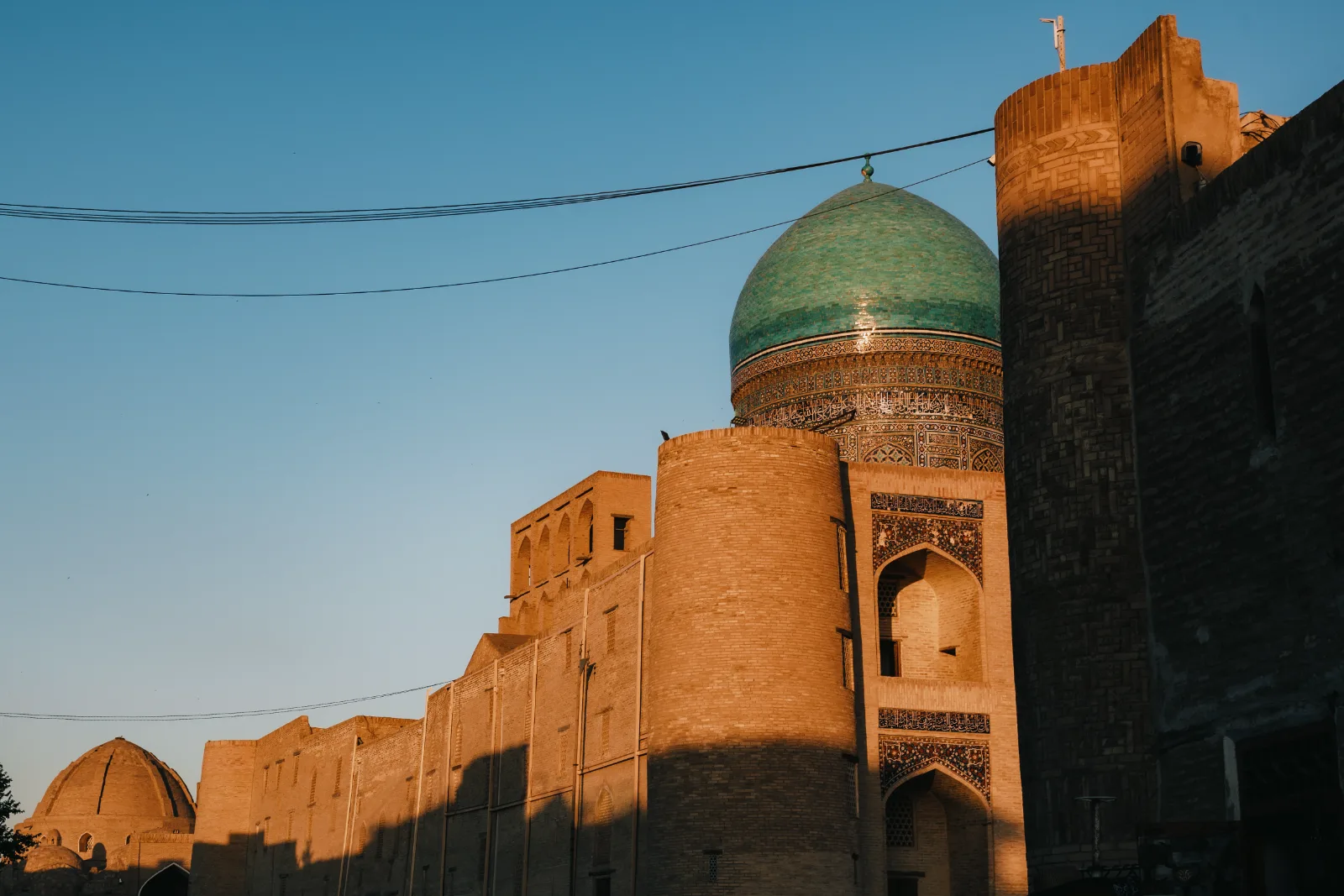
Days four through six are Bukhara, and this is where the pace actually slows down, which is the point. A morning at the Kalyan minaret and the surrounding madrasahs, still functioning as a working religious complex, not a museum piece cordoned off behind rope. An afternoon at a suzani embroidery session where the artisan corrects your tension by touch, not by explaining the theory of it. A separate day for a plov cooking workshop, because you cannot understand Uzbek hospitality culture from a restaurant table — you understand it from someone correcting how you're holding the ladle.
Day seven is the flight home, or onward, depending on where you're headed next.
What slows you down, and why that's the point
The honest version of this itinerary includes admitting where it's inefficient. Bukhara to Samarkand by train is under two hours and painless. Getting from a workshop's back room to the next scheduled stop, when the artisan is mid-sentence about a technique passed down from her grandmother, is not something you can rush without it feeling rude — because it is rude. A seven-day pace lets a session run twenty minutes long without torching the rest of the day. A five-day pace does not.
You also will not produce anything good in a two-hour session, on any of these three stops. My suzani stitches were uneven enough that the artisan, gently, unpicked the worst four and redid them in front of me so I could see the difference under her hands rather than in a diagram. That's not a failure of the itinerary. That's what two hours of a craft that takes years actually buys you — a real sense of the difficulty, not a souvenir that pretends you mastered it.
Why small groups matter here
In a group of twenty, an artisan spends the session performing a demonstration once and then supervising from a distance. In a group of eight, she has time to sit next to each person, correct grip and tension individually, and answer the follow-up question that only occurs to you once your hands are actually on the material. The itinerary above only works with a group small enough that the artisan can teach instead of perform — cap it any higher and days four through six collapse back into the museum-tour version of the trip you were trying to avoid.
What you leave with
Not just the ceramics bowl, the embroidery square, and the plov recipe scrawled in a notebook — though those are real, and they're yours. You leave with an accurate sense of how much time each city actually needs, which is the thing every conflicting "best itinerary" post online gets wrong by trying to compress it. Tashkent needs a day. Samarkand needs two, mostly for Registan light and the embroidery session. Bukhara needs three, because that's where the pace of the city itself finally slows down to match the pace of learning something with your hands.
CraftNCulture runs this route as the 7-Day Living Traditions of the Silk Road tour, capped at a small group size, roughly $1,850 per person including the artisan sessions in all three cities. If seven days sounds like too much time off work, it isn't — it's the minimum time this itinerary needs to stop being a checklist.
About the author
CraftnCulture
The CraftnCulture editorial team — Tashkent-based cultural tourism specialists covering Uzbekistan travel, artisan crafts, and Silk Road heritage.